
Are Mortgage Rates Too High to Invest in Rental Property?
When mortgage rates rise, many would-be real estate investors decide to wait. They hope rates will come down, prices will fall, or the “right time” to buy will become obvious.
But waiting for a perfect rate can mean putting a sound investment plan on hold. Mortgage rates matter, but they are only one part of a rental property’s performance.
Today’s rates are near their long-term average
As of September 24, 2026, Freddie Mac reported an average 30-year fixed mortgage rate of 7.03%. That’s far above the unusually low rates of 2020 and 2021, when the annual average fell below 3%. But over the full history of the survey, going back to 1971, the average has been around 7.7%.
In other words, today’s rate may feel high if you compare it with the recent lows. Compared with the wider history of mortgage lending, it’s closer to ordinary.
That doesn’t mean a 7% loan is inexpensive—or that every rental property is a good investment. It means an investor shouldn’t judge the opportunity by the interest rate alone.
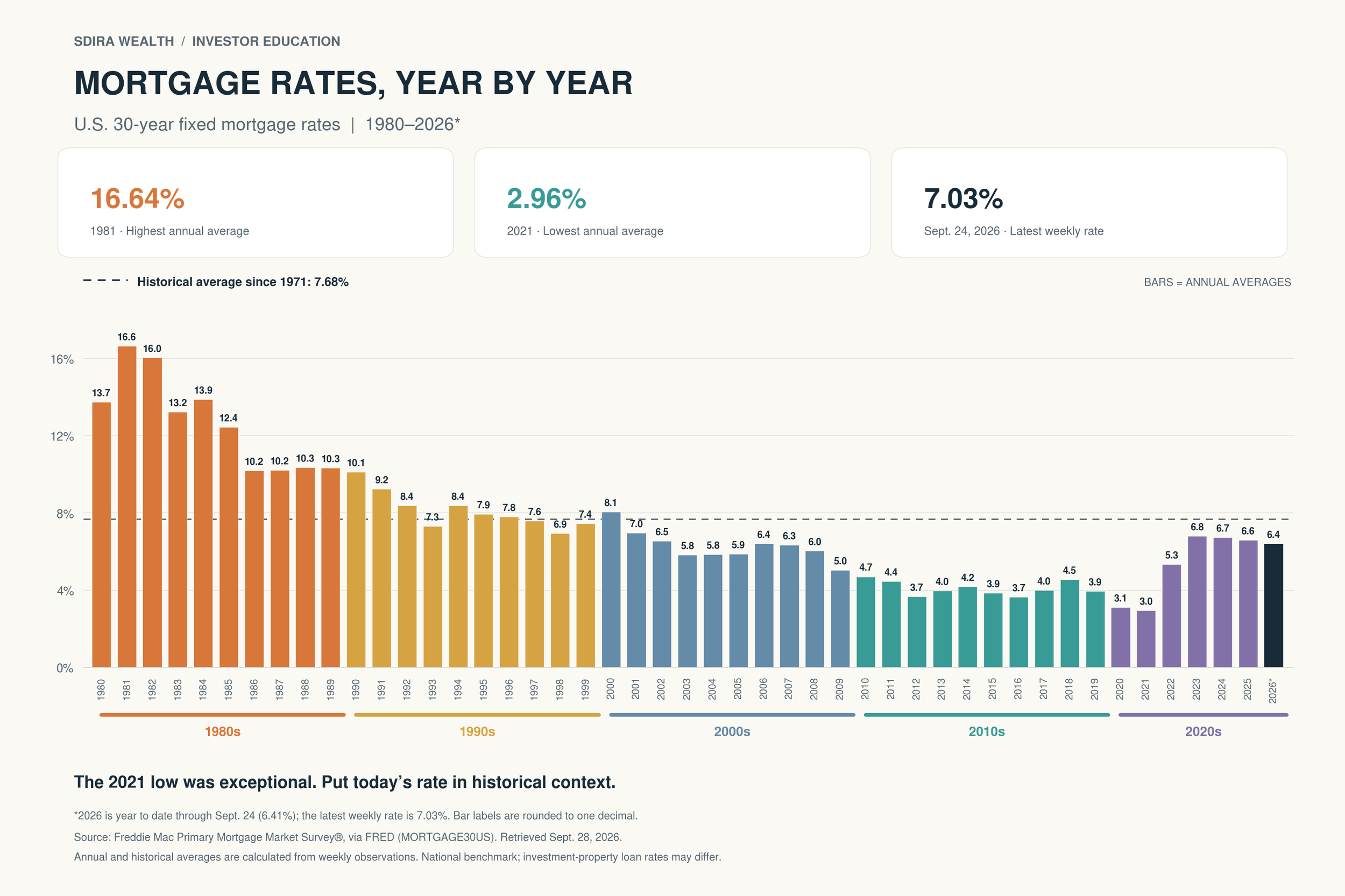
Chart showing annual U.S. 30-year fixed mortgage rates from 1980–2026, including the 16.64% high in 1981 and 2.96% low in 2021. The latest weekly rate of 7.03% is compared with the 7.68% historical average since 1971. The 2026 bar shows year-to-date data through September 24.
The property’s numbers matter more than the headline rate
Before buying, look at the whole investment: the purchase price, expected rent, taxes, insurance, maintenance, vacancy, property management, financing costs, and the amount of cash you’ll need to hold in reserve.
Then ask whether the property still fits your goals using realistic assumptions. Can the plan handle a vacancy or an unexpected repair? Does the rent estimate reflect the local market? Does the investment work without assuming that home prices will rise quickly or that you’ll be able to refinance later at a lower rate?
A lower rate can improve the numbers. But a low rate can’t make a poorly priced property a strong investment. And a higher rate doesn’t automatically make a well-planned property a bad one.
Don’t build your plan around a future refinance
Some investors buy now expecting to refinance when rates fall. That could happen, but the timing and terms are uncertain. Rates may not decline when expected, and refinancing depends on factors such as the property’s value, the borrower’s finances, lender requirements, and closing costs.
A more durable approach is to evaluate the property using the financing available today. If the numbers work under reasonable assumptions, a future refinance could be an option—not the foundation of the investment plan.
Waiting has a cost, too
Waiting can be the right choice if a property doesn’t meet your financial criteria or you’re not prepared to own it. But waiting only for rates to drop has no guaranteed payoff. Rates could fall while property prices or competition rise. They could also stay near current levels longer than expected.
Rather than trying to predict the perfect moment, investors can focus on the parts they can evaluate: their goals, available capital, local rental demand, property condition, financing terms, and long-term ownership plan.
Make a strategy-led decision
Real estate investing is not about buying a property just because rates are “normal,” or avoiding one just because rates are higher than they were a few years ago. It’s about understanding what you’re buying, how it fits your plan, and whether you can manage the investment through different market conditions.
Mortgage rates are an important input. They shouldn’t be the only reason to buy—or the only reason to wait.
At SDIRA Wealth, we believe investors should start with their goals and strategy, then evaluate properties against that plan. Build the portfolio with a plan—not by trying to time the perfect rate.
Ready to explore rental properties with a plan?
SDIRA Wealth clients can access our network of 200+ lenders, along with potential lender incentives and rate buydown opportunities on eligible properties and financing programs. Availability and terms vary, so our team can help you understand what may fit your goals.
Start with your strategy, then explore the property and financing options that support it.